Mahjong Alchemy
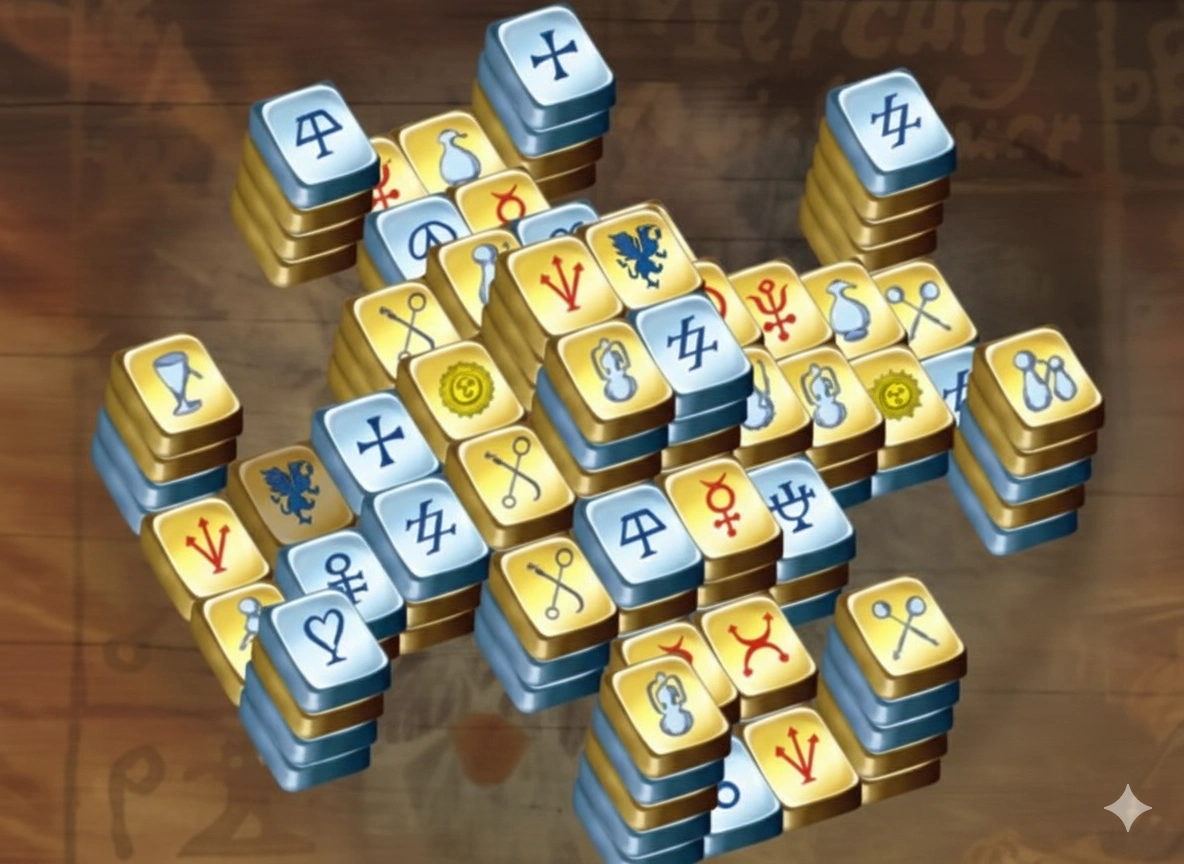
Mahjong Alchemy on this page is Arkadium's Mahjongg: Age of Alchemy, delivered through GameDistribution and syndicated across sites as different as AARP and the Washington Post's own games page. It swaps the usual bamboo and circles for alchemical symbols: moons, mercury signs, dragons, potion bottles. On our test the board loaded straight in with no video ad in front of it. The rule that catches people off guard: two tiles only match when they share the same symbol and the same color, not just the same picture.
A match needs the same color, not just the same symbol
Standard mahjong solitaire only cares about the icon. This one adds a second condition: every symbol comes in a gold version and a blue version, and a pair only clears when both the icon and the tile color match. Arkadium's own strategy notes for the game spell it out directly: you need to match both the symbol and the color of the tiles, and if either one is off, the pair won't disappear. In our test, clicking two identical gold tiles marked New Moon cleared them and added 313 points to the score in a single move.
The board comes from a pool of named layouts, not one fixed shape
Reloading the page across three separate tests gave us three different starting boards: Twin Peaks, The Well and Stone Circle, each a distinct tile arrangement rather than a cosmetic reskin. The Well deals tiles into a diamond frame around a hollow center; Twin Peaks and Stone Circle stack into a solid pyramid instead. Arkadium lists more names in the same rotation, so which one you land on the first time is chance, not a level select screen.
Five reshuffles a game, and each one costs you time
The in-game help screen describes the "Deal New Tileset" button as moving on to the next of five tilesets. Arkadium's own strategy guide calls the same button a reshuffle and adds a detail the in-game text leaves out: using it removes time from the clock as it shuffles the tiles. There's no hint button and no undo anywhere in the interface. If a color-and-symbol pair ends up buried out of reach, that reshuffle is the only way out, and it always costs you seconds.
Scoring adds up faster than the screen explains
One match added exactly 313 points on our board, more than a flat per-tile count would suggest. Arkadium's published formula explains why: each match scores tile value times tile count times a 100 or 110 percent multiplier depending on whether a hint was used, plus ten points for every second left on the clock when a tileset clears, plus a flat 1,000 for finishing the board, plus separate bonus points for chains of fast matches. None of that arithmetic shows up anywhere on screen while playing; the score counter just jumps.
Two ways to look at the same board
The Menu button opens a small options card with Sound on and off, plus a choice between Perspective View and Front View. Perspective is the default, and it tilts the board so tiles further back look smaller, which is what makes the layout read as a stacked pyramid at first glance. Front View flattens that angle and makes it easier to spot which tiles are actually free, at the cost of losing any sense of depth between layers.
On a phone, the top bar loses its labels
At 375 pixels wide the game keeps working in portrait; it never asked us to rotate the screen. But the four controls across the top get clipped by the frame: "Deal New Tileset" reads as "ew Tileset" and "Menu" shows only a stray "M". Taps on tiles still land correctly and the tiles themselves stay legible, but reading which button is which takes a guess.
The Google Play and App Store links aren't this game
The Google Play button on this page points to an app called Alchemy Craft & Merge Elements, built by a developer named Pavel Ilyin. It's a crafting and merging game with no mahjong tiles in it at all. The App Store link goes to Mahjong: Alchemy, a separate three-star app made by Centaur Games, unrelated to Arkadium. If you came here looking for a phone version of the browser game, neither store listing is it.
If the color rule puts you off
- Mahjong Solitaire for a hint button instead of a five-use reshuffle.
- Mahjong Titans for a single fixed spiral board with no reshuffle at all.
- Mahjong Connect if you'd rather match by drawing a path than by clearing a stack.
- Vita Mahjong for an undo button, which this one doesn't have.
Three quick answers
Is there a hint button in Mahjong Alchemy?
No. The only help on offer is the five-use reshuffle, and using it costs time off the clock rather than being free.
How long is the timer?
Fifteen minutes per tileset, counting down from 15:00 in the corner of the board, matching what Arkadium's own listing states.
Why does the board have a name like Twin Peaks or Stone Circle?
Arkadium draws each session's starting board from a pool of named layouts. Ours came up Twin Peaks, The Well and Stone Circle across three separate loads, and the name has no effect on the rules.